The problem
Cognitive rehabilitation needs structured practice, but everyday tasks are difficult to recreate consistently in busy clinical and community settings.
VR rehabilitation
CorteXR turns everyday rehabilitation tasks into structured VR practice for stroke recovery, developed with the people who understand the pathway.
Problem and solution
After a stroke, people often need to relearn everyday routines: preparing food, organising steps, navigating tasks and rebuilding confidence. Therapy time is limited, and support can become harder to maintain as people move from hospital into the community.
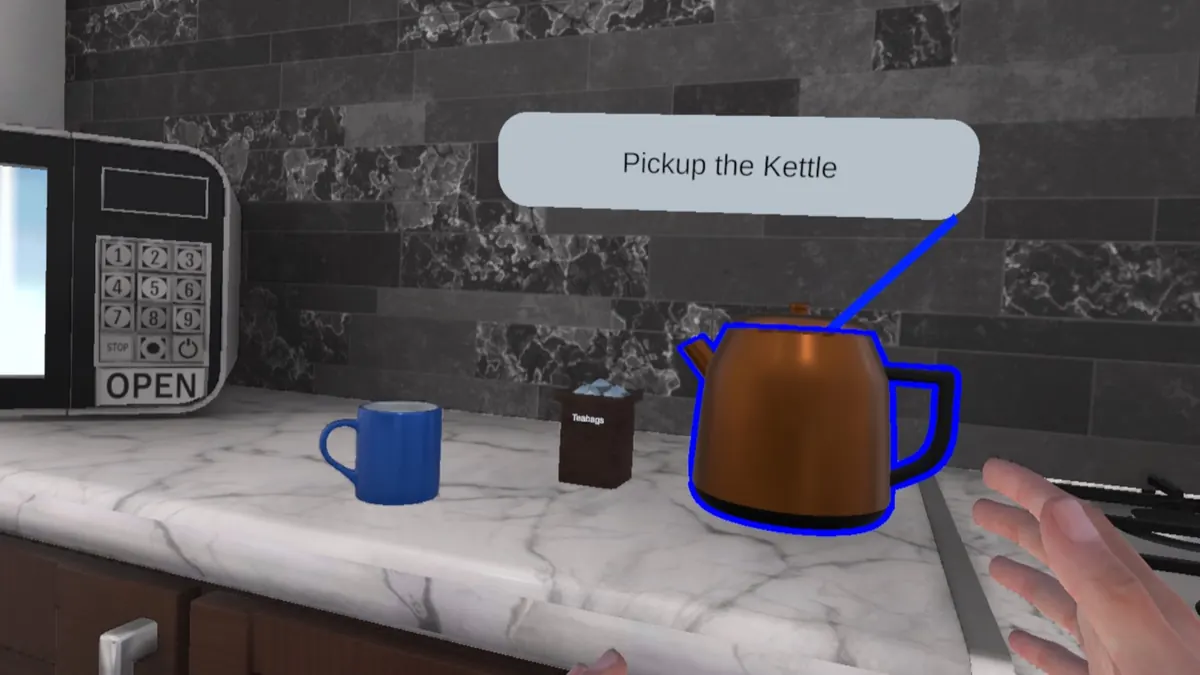
CorteXR turns those routines into structured VR activities that can be repeated, adapted and discussed with rehabilitation teams. The product focuses on cognitive rehabilitation and activities of daily living, where sequencing, attention and confidence matter as much as simple physical movement.
The work began under the Virtue name and has developed through research, product development, certification activity and real-world evaluation planning. The product is designed to make rehabilitation practice more accessible, measurable and engaging.
Cognitive rehabilitation needs structured practice, but everyday tasks are difficult to recreate consistently in busy clinical and community settings.
CorteXR creates safe VR activities based on real-world routines, with adjustable difficulty and clear tasks that rehabilitation teams can recognise.
The product grew through funded R&D, clinical input, therapist feedback and involvement from stroke survivors and families, under its earlier Virtue name.
Practice is built around recognisable routines such as preparing food and organising multi-step activities.
Shaped with stroke clinicians, therapists, researchers and stroke-survivor input.
Developed through funded R&D, certification work and ongoing evaluation.
What the experience includes
Trust signals
What it shows
CorteXR shows how Nudge Reality translates rehabilitation knowledge into interaction design, working software, documentation inputs and product evaluation.
For organisations exploring healthcare XR, the value is in the combination: user engagement, clinical input, product discipline and a build that can keep improving with the people who understand the setting.