The problem
Stroke assessment is high-pressure and highly contextual, but training content can struggle to recreate realistic patient behaviour and clinical setting.
Healthcare training
VR training for stroke and TIA assessment, helping learners practise recognition, triage and thrombolysis decisions with reconfigurable patient avatars.
Problem and solution
Stroke and TIA assessment depends on recognising signs, asking the right questions, interpreting patient responses and making time-sensitive decisions. Those skills are difficult to build from static teaching content alone.
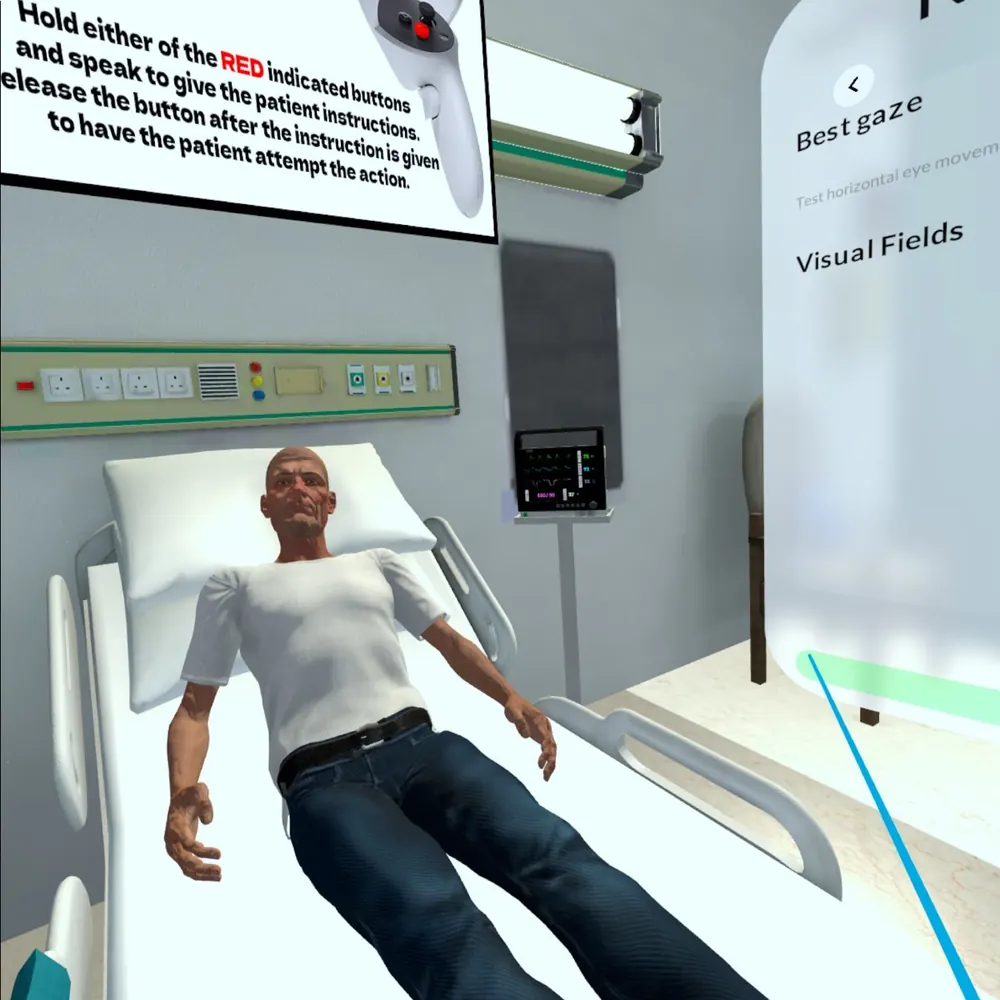
StrokeID creates immersive acute-care scenarios where trainees interact with reconfigurable patient avatars in settings such as A&E and general wards. The simulation lets learners practise clinical conversations, observations and decision-making in a repeatable environment.
The product idea came from a practical training need: improve recognition and understanding of stroke and TIA, support acute assessment and triage, and give learners a safer place to practise thrombolysis-related decision-making.
Stroke assessment is high-pressure and highly contextual, but training content can struggle to recreate realistic patient behaviour and clinical setting.
VR scenarios combine clinical environments, patient history, monitors, avatar responses and case-based tasks.
Requirements, case studies and refinements were shaped through stakeholder interviews, clinical-learning feedback and short development sprints.
Patient age, appearance, posture, limb movement and facial response can support different case scenarios.
Scenarios include ward or A&E context, patient history, equipment and monitoring cues.
The design allows for individual learning, remote participation and pre- or debriefing around the case.
What the simulation includes
Trust signals
How we worked
The project plan began with stakeholder interviews and requirements capture, then moved into simulation environment design, case implementation and testing. Development was organised around short sprints with feedback from the clinical learning team.
StrokeID shows how immersive software can move clinical teaching closer to real decision-making, with believable patient interaction, useful scenario structure and training moments clinicians can discuss after the headset comes off.