VR training development
VR training development for scenario-based learning.
Nudge Reality translates learning objectives, existing web-based modules and subject-matter expertise into immersive scenarios where learners have to notice, decide, act and debrief.
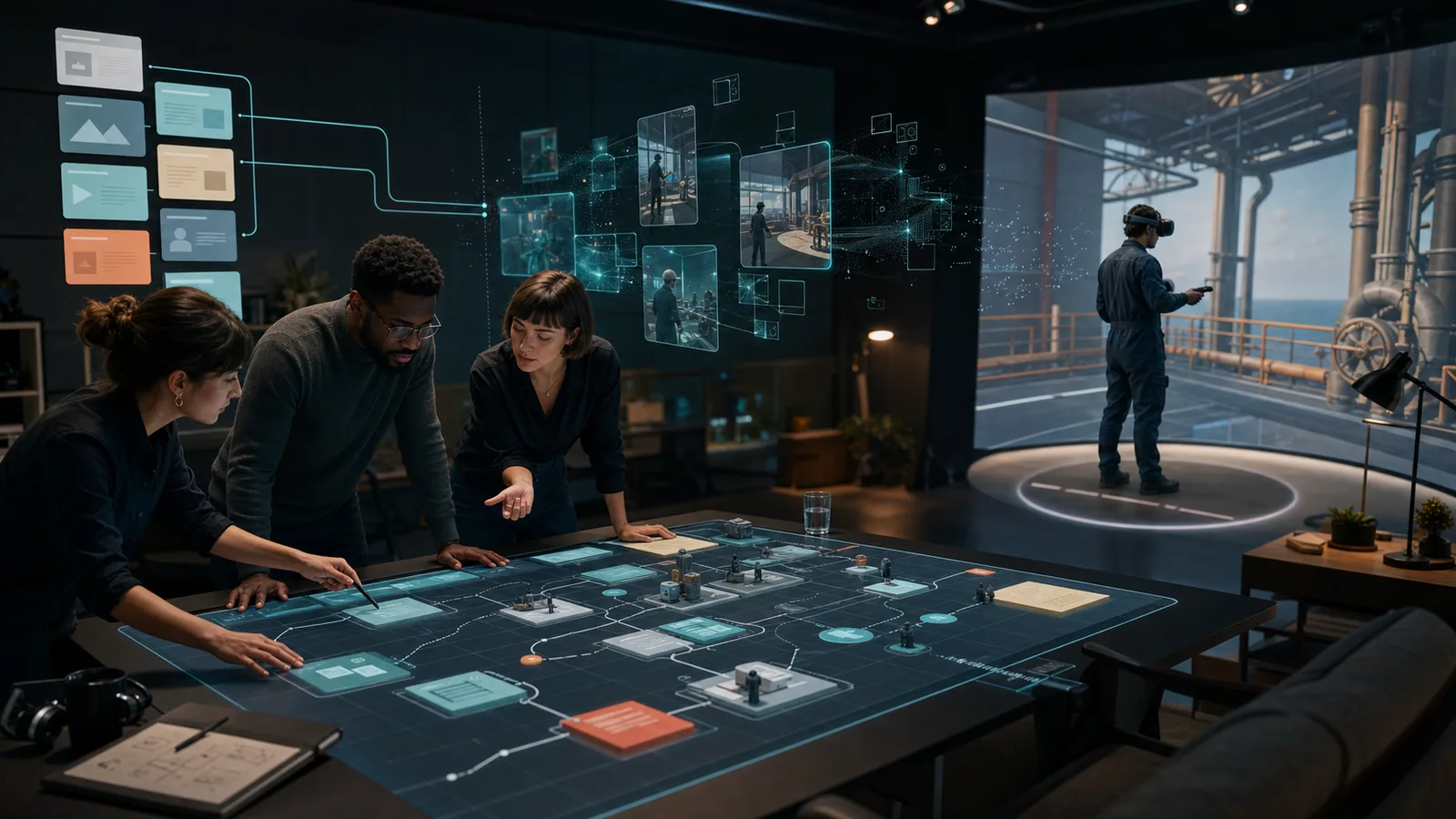
VR training development
Effective VR training depends on clear learning design. The starting point is not the headset; it is the learning objective, the operating context and the behaviour the learner needs to practise.
Nudge Reality translates learning objectives, existing training material and subject-matter expertise into interactive scenarios. The result can be a headset simulation, a blended learning module, a WebXR demonstrator, a trainer-facing tool, or a prototype used to test whether immersive training is the right direction.
Who this is for
- Training teams with high-value skills that are difficult to practise consistently.
- Organisations with web-based modules or slide-based training that need more active rehearsal.
- Healthcare educators building clinical assessment, procedure or communication simulations.
- Operational teams who need hazard awareness, planning, environment familiarisation or decision practice.
- Product and innovation teams preparing immersive training prototypes for funding or stakeholder review.
Learning objectives into XR scenarios
Many organisations already have web-based training, SOPs, slide decks, videos, assessment rubrics or LMS modules. Those assets often contain the right knowledge, but they rarely give the learner a meaningful place to apply it.
We convert existing material into XR content by identifying the moments where practice matters: judgement calls, sequencing, spatial awareness, communication, hazard recognition, clinical reasoning, roleplay, procedure confidence or team coordination.
A good VR training scenario does not simply reproduce a lesson in 3D. It asks the learner to make decisions, observe consequences and generate material for debriefing or assessment.
VR training simulations
- Scenario-based VR training for healthcare, industry, education and specialist teams.
- Conversion of existing web modules into practice-led XR activities and debriefable scenarios.
- Operational simulations for hazard awareness, planning, environment familiarisation and spatial judgement.
- Clinical or procedural rehearsal where decision-making and context matter as much as recall.
- Prototype simulations for funding, stakeholder review or early curriculum testing.
- Supporting dashboards, browser tools or scenario viewers where the headset experience is part of a wider training workflow.
Development process
We usually begin by mapping the learning objective against the real task. What should the learner notice? What choices matter? What information is available at the point of decision? What does good performance look like? What should an instructor or manager be able to discuss afterwards?
From there we define the scenario structure, interaction model, environment requirements, feedback approach and content scope. We can then build a prototype, test it with stakeholders and expand it into a fuller simulation or training product.
For some projects, the right first step is a small XR prototype. For others, it is a more complete VR training simulation with scenario variation, instructor tools, learner progress data or companion web content.
Deliverables can include
- Learning-objective mapping and scenario design.
- VR training prototypes or full headset simulations.
- WebXR previews, trainer dashboards or supporting browser tools.
- 3D environments, interactive props, virtual patients, avatars or operational settings.
- User testing support, stakeholder review builds and technical handover.
Relevant VR training work
DroneOps VR explores drone hazard awareness, planning and operational decision-making. TrainTrach and StrokeID show healthcare training scenarios. StageCraftVR uses immersive practice for creative education and staging decisions.
Across these projects, the scenario design starts with the decisions and behaviours the learner needs to rehearse, then builds the XR interaction around that practice.
Frequently asked questions
Can you convert existing training modules into VR?
Yes. Existing web modules, SOPs, videos and slide decks can be a useful starting point. We identify which parts should remain conventional content and which parts become interactive XR practice.
Does every VR training project need a full headset simulation?
No. Some projects start with WebXR, a scenario prototype or a blended workflow where the headset is only one part of the training experience.
Can VR training include assessment or debriefing?
Yes. The design can include observable actions, decision points, scenario outcomes and trainer-facing notes. For some projects, we can also build companion tools for briefing, observation or debriefing.
Which sectors do you support?
Our strongest fit is healthcare, operational training, education, simulation and specialist skills where context and judgement matter. For broader service context, see immersive training simulation and XR prototype development.